Bedding & nursery guide
Organic Crib Mattress Materials: What Parents Should Compare
An “organic” label is a useful starting point, not a complete buying guide. To compare crib mattresses with confidence, look closely at the materials inside, the surface your baby sleeps on, the scope of each certification, and the fit and care instructions that shape everyday use.
Preparing a nursery often means weighing dozens of choices at once. A crib mattress can seem deceptively simple: it should fit the crib, feel firm and flat, and be made from materials a family is comfortable bringing into the home. Yet products described as organic may differ significantly in their cores, covers, waterproofing, seams, and certification claims. The details matter more than a single word on a label.
This guide offers a practical way to compare organic crib mattress materials without treating any one fiber or brand as an automatic answer. It explains what to ask about the core and surface, how to read certification language, why fit and firmness deserve priority, and how a product such as the Naturepedic Breathable 2-Stage Organic Crib Mattress can serve as an example of the specifications parents may want to examine.
At a glance: what to compare
- Core: Identify the materials that provide the mattress’s structure and support.
- Cover and surface: Check the fabric, finish, seams, and any waterproof layer.
- Certifications: Confirm which components and stages of production a certification covers.
- Fit and firmness: Follow crib and mattress manufacturer guidance, and prioritize a snug, flat, firm sleep surface.
- Care: Understand how the mattress and any removable pad are cleaned and dried.
Start with the core, not the headline claim
The core is the structural heart of a crib mattress. It determines how the mattress holds its shape and provides support, and it may be made from materials such as cotton, latex, foam, or an innerspring system. A material name alone does not tell you everything about construction or performance, so look for a clear description of what is inside and how the layers are arranged.
Some organic crib mattresses use cotton-based construction. Cotton may be present in the core, batting, or outer fabric, and those are not interchangeable descriptions. Ask whether the cotton is used for structural support, surface padding, or both. A product may feature an organic cotton cover while using a different material for its support core; understanding that distinction helps avoid confusing “made with organic cotton” with “entirely organic.”
Latex is another material parents may encounter. If a mattress contains latex, check whether the product identifies the type and whether the material is certified. Latex can be a relevant consideration for households with known sensitivities, so families should review the manufacturer’s disclosures and consult a healthcare professional when they have specific allergy concerns. “Natural” does not mean that a material is suitable for every person.
Other designs may use coils or engineered support structures. The important comparison is not simply natural versus synthetic, but whether the manufacturer describes the materials transparently, explains the construction, and provides care and safety guidance. If a listing offers only broad assurances without identifying the main components, ask for a detailed materials list before deciding.
Compare the sleep surface and waterproofing
A mattress’s cover is the part closest to the fitted sheet, but its construction can involve several layers. Check the face fabric, any quilted or padded layer, the seams, and whether a waterproof barrier is built into the mattress or provided as a separate pad. Each layer has a different role, and product descriptions should make those roles understandable.
Water resistance is a practical consideration in a nursery, where spills and accidents may occur. Some mattresses use a wipe-clean surface; others rely on a removable pad or protector. Ask what the waterproof layer is made from, how it is attached, and how it should be cleaned. A waterproof surface can help limit liquid reaching the inner core, but it does not replace prompt cleaning or careful drying according to the manufacturer’s directions.
Breathability claims also deserve a closer look. A product may describe a removable pad as breathable or a cover as airflow-friendly, but these claims do not substitute for safe-sleep guidance. Follow current recommendations from your child’s healthcare provider and relevant public-health authorities. The mattress should be used as directed, with a properly fitted crib sheet and no extra bedding or accessories that are not recommended for the baby’s sleep space.
Consider whether the mattress has a removable, washable component and whether that component can be fully dried before use. A washable pad may make routine care more convenient, while a wipe-clean mattress surface may simplify spot cleaning. Neither approach is universally best: the right choice depends on the household’s priorities and on whether the cleaning process is realistic to maintain.
Read certifications with precision
Certification can help verify particular claims, but it is not a single, all-purpose verdict on a mattress. A certification may apply to a fiber, a finished textile, a material input, or a manufacturing facility. Parents should look for the certifier’s name, the specific standard, the product or component covered, and whether the manufacturer provides a certificate or other way to verify the claim.
For example, GOTS—the Global Organic Textile Standard—sets requirements for organic textile processing and related environmental and social criteria. Its relevance depends on what has been certified. A GOTS-certified cotton cover does not automatically establish that every component of a complete mattress is organic or certified. Read the wording carefully, and ask which parts of the finished product fall within the certification’s scope.
Other certifications may address different questions, such as emissions or chemical testing. They should not be treated as interchangeable with an organic certification. A claim about low emissions, for instance, is not the same as a claim about the agricultural origin of a fiber. The useful question is: What does this credential verify, and which part of this particular mattress does it cover?
Be alert to vague terms such as “eco,” “green,” “clean,” or “non-toxic” when they appear without supporting details. Such language may describe a brand’s general positioning rather than a standardized, independently verified attribute. Clear material disclosure and accessible documentation are more helpful than a long list of badges whose meanings are difficult to distinguish.
- Find the full name of each certification and the standard it refers to.
- Check whether the claim applies to the fabric, core, component, or complete product.
- Look for current documentation and verify that it refers to the product in question.
- Keep organic, emissions, chemical, and performance claims distinct.
- Contact the manufacturer if the scope of a claim is unclear.
Fit, firmness, and safe use come first
Materials are important, but a mattress must also be compatible with the crib. Check the crib and mattress manuals, measure the sleep surface as instructed, and make sure the mattress fits snugly in the frame. A poorly fitting mattress can leave gaps; do not rely on a retailer’s general size label alone when the crib manufacturer provides specific fit guidance.
For infants, a firm, flat sleep surface is a central safety consideration. A mattress marketed as plush, cushioned, or especially soft should not be assumed suitable for infant sleep simply because its materials are organic. Review the product’s intended use, age or stage guidance, and applicable safety information, and follow the recommendations of your pediatric healthcare provider and public-health authorities.
Some models are designed with different sides for different stages. In a two-stage design, one side may be intended for infant use and another for a toddler, but the stage labels are not a substitute for checking the instructions. Confirm which side should be used at each stage, whether the mattress should be flipped, and what changes—if any—are appropriate as the child grows.
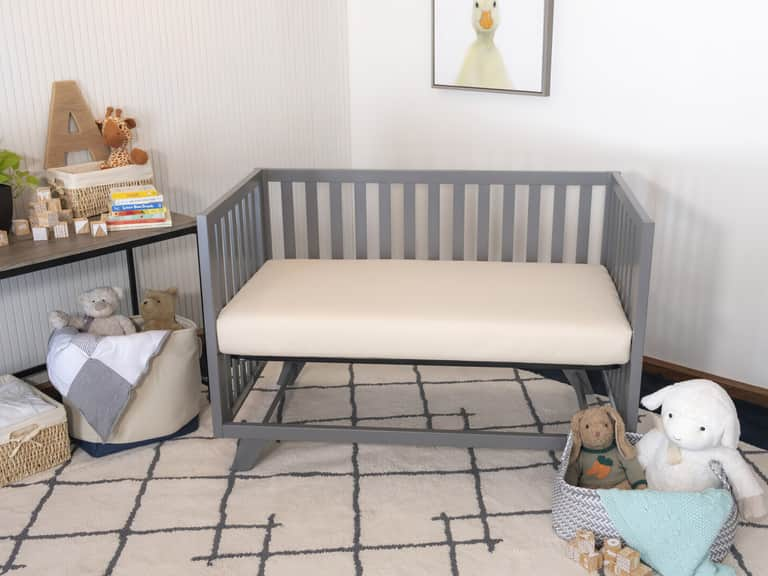
The Naturepedic Breathable 2-Stage Organic Crib Mattress illustrates several points worth comparing. Its product information describes a firm, flat mattress with a removable breathable and washable pad, two intended stages, a wipe-clean waterproof infant side, and a support structure offered in lightweight or traditional innerspring versions. The listing also gives approximate dimensions of 27¼ by 51⅝ by 6 inches and identifies organic cotton construction and GOTS certification. Parents should confirm current specifications, crib compatibility, and use instructions directly against the product documentation before purchase.
That example is useful not because any single feature determines the right choice, but because a detailed listing gives parents specific questions to evaluate: What supports the mattress? What does the removable pad do? How is the waterproof surface constructed? Which components are certified? How do the dimensions compare with the crib? Good comparison begins with those concrete answers.
Separate material preference from performance claims
Parents often look for organic materials because they want to understand how a product is made and what it contains. That is a reasonable priority, but organic status should not be treated as proof of every other benefit. It does not, on its own, guarantee a mattress will feel comfortable to a particular child, prevent allergies, improve sleep, or be safer in every respect. Those outcomes depend on a range of factors and should not be promised by marketing language.
Likewise, words such as “hypoallergenic” and “chemical-free” require careful interpretation. No material can necessarily be described as free of every chemical, and “hypoallergenic” does not mean that reactions are impossible. If your household has a known allergy or sensitivity, review the full materials list, identify potential allergens, and speak with a qualified clinician for individualized advice.
Think of the organic claim as one part of a broader assessment. You might prioritize a certified textile, a particular core material, a washable layer, or a product that provides unusually clear ingredient information. The right priorities differ by household. A useful buying decision comes from matching verified product attributes to your needs rather than assuming one label settles every question.
Consider maintenance before you buy
A mattress is a long-term household item, and its care requirements affect daily usability. Determine whether the cover can be removed, which components can be washed, and whether cleaning should be done by hand or with a household machine. Check water temperature, detergent guidance, drying instructions, and any restrictions on bleach or high heat. A component that is washable but difficult to dry completely may be less convenient than it first appears.
Ask how the mattress should be handled after a spill. Some surfaces may be wiped with a damp cloth; others may require a specific cleaner. Avoid improvised treatments that could damage a waterproof finish or leave residue. If a removable pad is part of the design, confirm whether replacement pads are available and whether the mattress is intended to be used with that pad in place.
Inspect the mattress periodically for damage, changes in shape, broken seams, or a surface that no longer lies flat. Follow the manufacturer’s guidance for storage and use, and do not continue using an item that appears damaged or does not fit correctly. Clear care instructions are a mark of a product that is easier to assess and maintain.
A practical comparison checklist
When reviewing a product page or speaking with a retailer, use the following checklist to keep the comparison focused:
- Identify the core. What provides structural support, and are the layers described clearly?
- Map the surface. What is the cover made of? Is there padding, a waterproof membrane, or a separate pad?
- Check the organic claim. Which materials are described as organic, and what documentation supports that statement?
- Examine certification scope. Does the certification cover a fiber, a finished textile, a facility, or the whole mattress?
- Confirm the intended stage. Is the mattress designed for infant use, toddler use, or both, and what do the instructions say?
- Measure for compatibility. Compare the stated mattress dimensions with the crib maker’s requirements.
- Review care steps. Understand what can be washed, wiped, or removed and how each component must dry.
- Look for complete disclosures. If materials, finishes, or waterproofing are not explained, request clarification.
Questions parents commonly ask
Does “organic crib mattress” mean the entire mattress is organic?
Not necessarily. The term may refer to specific fibers or textiles rather than every component. Check the materials list and certification documentation to learn exactly what is covered. A transparent description distinguishes the cover from the core, waterproof layer, and any removable pad.
Is cotton always the best core material?
No single material is automatically best for every family. Compare the construction, support design, certification, fit, cleaning requirements, and manufacturer instructions. The word “cotton” may describe a cover or padding rather than the mattress’s main support structure.
Does a breathable surface replace safe-sleep practices?
No. A marketing description about airflow does not replace established safe-sleep guidance. Follow instructions from your healthcare provider and relevant public-health authorities, and use the mattress only as intended.
What should I do if the product page does not specify every material?
Ask the manufacturer or retailer for a complete component list and the scope of any certifications. If important details remain unclear, compare another product with more specific documentation. Clear information is essential when you are evaluating materials and fit.
Can I use an additional protector or pad?
Use only accessories that are compatible with the crib and mattress and permitted by the manufacturer’s instructions and current safe-sleep guidance. An added layer may affect fit or the sleep surface, so do not assume that any protector is suitable simply because it is labeled organic or waterproof.
The considered choice
Choosing an organic crib mattress is ultimately an exercise in careful reading. Look beyond broad promises and compare the structure, surface, certification scope, dimensions, intended use, and care instructions. Organic materials can be a meaningful preference, but they are most useful when supported by specific, verifiable information.
A well-informed decision does not require decoding every technical term on your own. It means knowing which questions to ask and checking that the answers are consistent across the product description, certification records, and manufacturer’s instructions. Keep crib compatibility and appropriate sleep-surface guidance at the center of the decision; then weigh material preferences and household priorities with a clearer view of what each mattress actually offers.